Did You Know?
Earthquakes send out a fast, weaker wave before the slower, stronger shaking. In California, Oregon, and Washington, an early warning system uses that head start to send alerts to phones, sometimes seconds before the strong shaking arrives.
The Numbers Behind the Career
The median annual salary for geoscientist was $101,920.
About 1,800 geoscientist job openings are project each year over the next decade.
There were about 25,400 geoscientist jobs in the U.S. in 2025 in the category that includes geologist.
Where This Career Is Headed
The next decade is likely to shift geology from mostly finding what is underground toward also putting things back and reusing what has already been dug up. In Iceland, a project called Carbfix has shown that carbon dioxide pumped into volcanic rock can turn almost completely into stone in less than two years, and in 2025 the U.S. Geological Survey released its first map of places that may hold natural hydrogen gas underground. Geologists are also studying old mine waste as a new source of useful metals. The ground itself is getting wired, too, since a technique called distributed acoustic sensing can turn an ordinary fiber-optic cable into thousands of earthquake sensors. As NASA prepares to land astronauts on the Moon again, geologists are leading field training so crews and mission teams can choose the most useful rocks to study. Geologists entering the field now will help decide what comes out of the ground, what goes back in, and how to do both safely.

New fields like natural hydrogen and underground carbon storage need geologists who can find the right rock and prove it is safe to use, creating jobs beyond traditional mining, oil, and gas.
Interest in recovering metals from old mine waste is growing, and geologists who understand how minerals form can help find and test these new sources.
Work tied to the Moon and other planets will need geologists who can read rocks they may never hold, using photos, instruments, and returned samples.
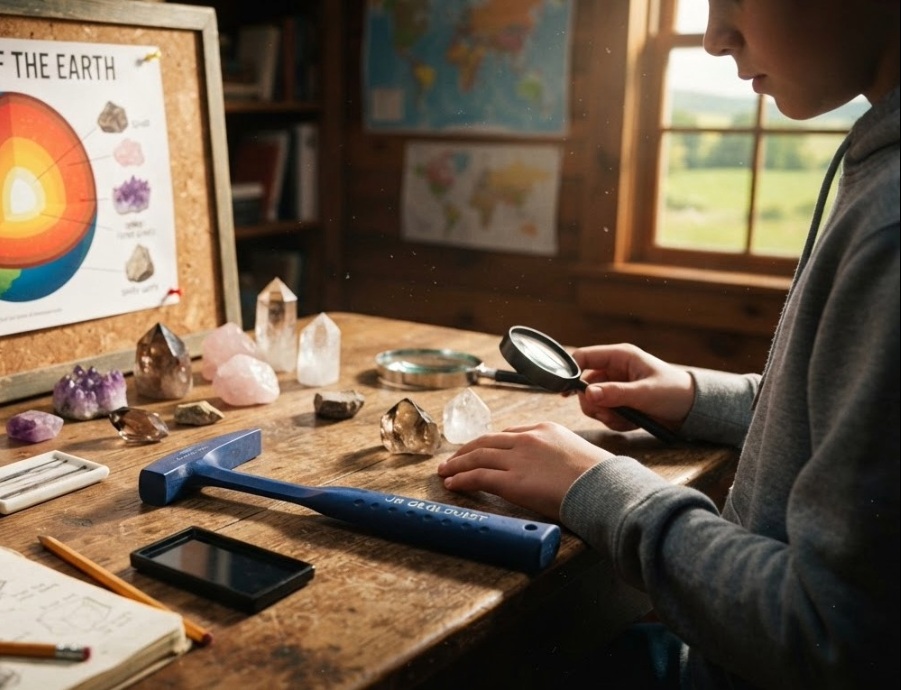
Education & Certification
Geologists typically need a bachelor’s degree in geology or a related earth science, with coursework in mineralogy, chemistry, physics, and math. Most programs include hands-on fieldwork, and internships add more experience before graduation. Some positions prefer a master’s or doctoral degree.
Most states require geologists who offer services to the public, such as on construction or environmental projects, to hold a Professional Geologist license. Licensing usually takes a degree, several years of work experience, and passing national exams, though requirements vary and some states do not license geologists at all.
To Prepare...
Take earth science, chemistry, physics, and the highest level of math your school offers, since geology programs build on all four.
Take geography or computer science if your school offers it, which builds map-reading and mapping software skills.
Join a hiking or outdoor club, or volunteer at a park or nature center, to practice working outdoors and reading terrain.