Photo: USGS, Public domain, via Wikimedia Commons
Who He Was
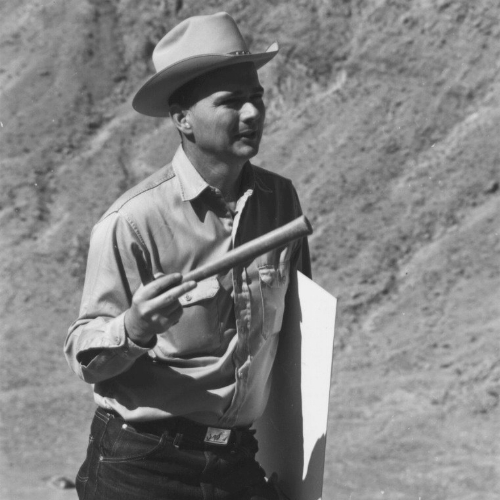
Eugene Shoemaker was a U.S. Geological Survey geologist who wanted to know whether volcanoes or space rocks hitting Earth made craters. In 1960, he and USGS colleagues Edward Chao and Beth Madsen reported finding coesite at Meteor Crater in Arizona, a form of silica that forms only under enormous pressure, such as an impact, which helped settle that the crater was made by a space rock. In 1961, he started the USGS program that studies the Moon and planets, and he helped train Apollo astronauts, although a health problem kept him from becoming an astronaut himself. In 1993, he, his wife Carolyn, and astronomer David Levy discovered a comet that had broken into pieces, and in July 1994 those pieces crashed into Jupiter, the first impacts of their kind people had ever watched. After his death in 1997, NASA's Lunar Prospector spacecraft carried a small capsule of his ashes to the Moon.
Why He Matters
Shoemaker’s work showed that space rocks have shaped the Earth and the Moon throughout their history, which turned craters from curiosities into evidence. His story shows how a geologist can turn an unsolved question into proof, by finding a mineral that pointed clearly to an impact. It also shows that geology does not stop at the edge of Earth, since the skills used on a crater in Arizona helped astronauts choose rocks on the Moon. His comet discovery gave scientists a rare chance to watch an impact in progress, and it showed why tracking space rocks matters. His career grew from curiosity about one crater into a lifetime of studying other worlds.