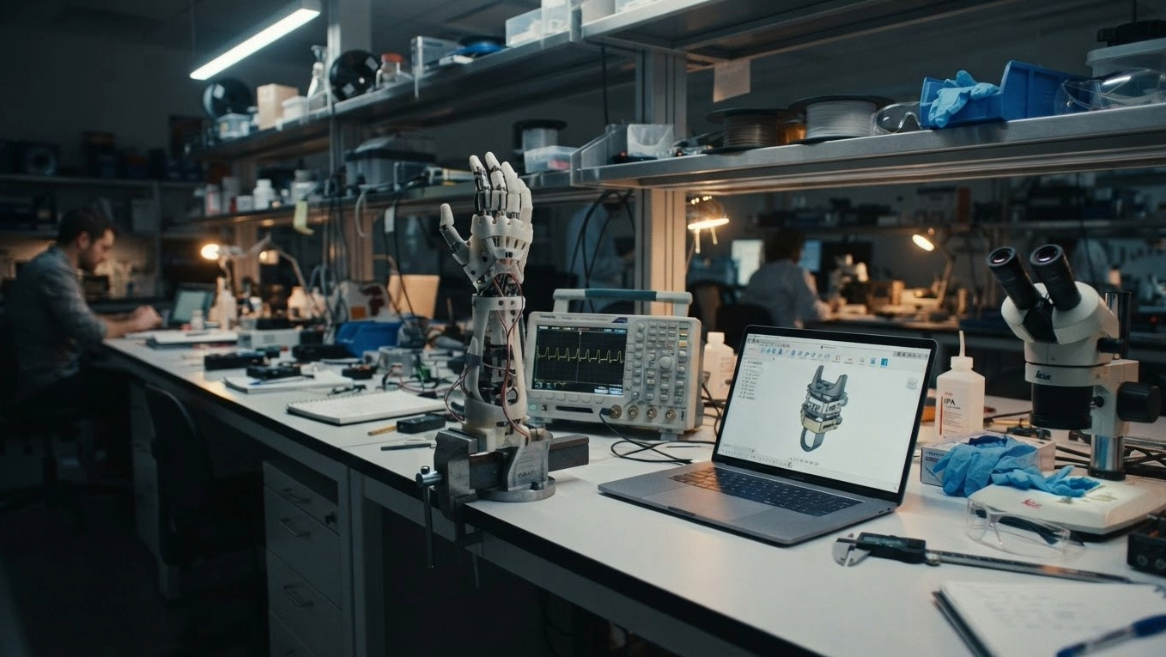
Did You Know?
A robotic prosthetic arm approved in 2014 was nicknamed the "Luke" arm, after Luke Skywalker's bionic hand in Star Wars. It reads electrical signals from the muscles in a person's remaining arm, and testers could use it to zip a coat, turn a key, and pick up an egg without cracking it.
The Numbers Behind the Career
The median annual salary for bioengineers and biomedical engineers in the United States was $109,370 in 2025.
There were about 23,800 bioengineer and biomedical engineer jobs in the United States in 2025.
About 1,200 openings for bioengineers and biomedical engineers are expected each year over the next decade.
Where This Career Is Headed
Biomedical engineering is being reshaped by artificial intelligence, new materials, and a closer connection between machines and the nervous system. The U.S. Food and Drug Administration has authorized roughly 1,450 medical devices that use artificial intelligence or machine learning, most of them tools that help radiologists read scans, and the pace of new approvals has accelerated sharply in the past few years. At the same time, engineers are 3D printing living tissue from a patient's own cells, building prosthetic limbs that connect directly to nerves and muscles, and developing tiny implants that can be placed through a blood vessel instead of open surgery. As the population ages and demand for joint replacements, heart devices, and remote monitoring grows, biomedical engineers who can combine deep knowledge of the body with software, data, and manufacturing skills will be best positioned over the next decade.

Artificial intelligence is creating new roles for engineers who can design, test, and validate software that reads medical images, monitors patients, and predicts problems before they become emergencies.
Advances in 3D bioprinting and tissue engineering are moving from the lab toward the clinic, opening a path toward printed cartilage, skin, and eventually more complex tissues built from a patient's own cells.
Wearable and implantable sensors are expanding what can be monitored outside a hospital, giving biomedical engineers a growing role in everything from smartwatches to devices that track blood sugar or heart rhythm around the clock.

Education & Certification
Most biomedical engineers hold at least a bachelor's degree in biomedical engineering, bioengineering, or a related engineering field such as mechanical or electrical engineering with added coursework in biology. ABET-accredited undergraduate programs blend classroom and laboratory work in subjects like fluid and solid mechanics, circuit design, computer programming, biomaterials, and physiology, and most include a major design project. Many programs also offer co-ops or internships with hospitals, medical device companies, or pharmaceutical manufacturers. A master's degree or doctorate is usually needed to lead a research team, and some biomedical engineers go on to medical school, law school to become patent attorneys, or business school to move into management.
A license is not required to work as a biomedical engineer. Engineers who want one can take the Fundamentals of Engineering exam near graduation and, after several years of experience, pursue a Professional Engineer license, usually in a related discipline such as electrical or mechanical engineering, since no exam is specific to biomedical engineering.
To Prepare...
Take as much math and science as you can, especially biology, chemistry, physics, and math through calculus, since these subjects are the foundation of every biomedical engineering program.
Learn a little computer programming and, if your school offers them, classes in drafting, computer-aided design, or engineering, because designing and simulating devices on a computer is a daily part of the job.
Get hands-on experience through robotics clubs, science fairs, maker spaces, or summer engineering programs, and look for chances to see how hospitals and clinics actually use technology.