

Did You Know?
A single teaspoon of healthy forest soil contains more living organisms than there are people on Earth, including billions of bacteria, thousands of fungi, and countless microscopic creatures that ecologists are still working to identify.
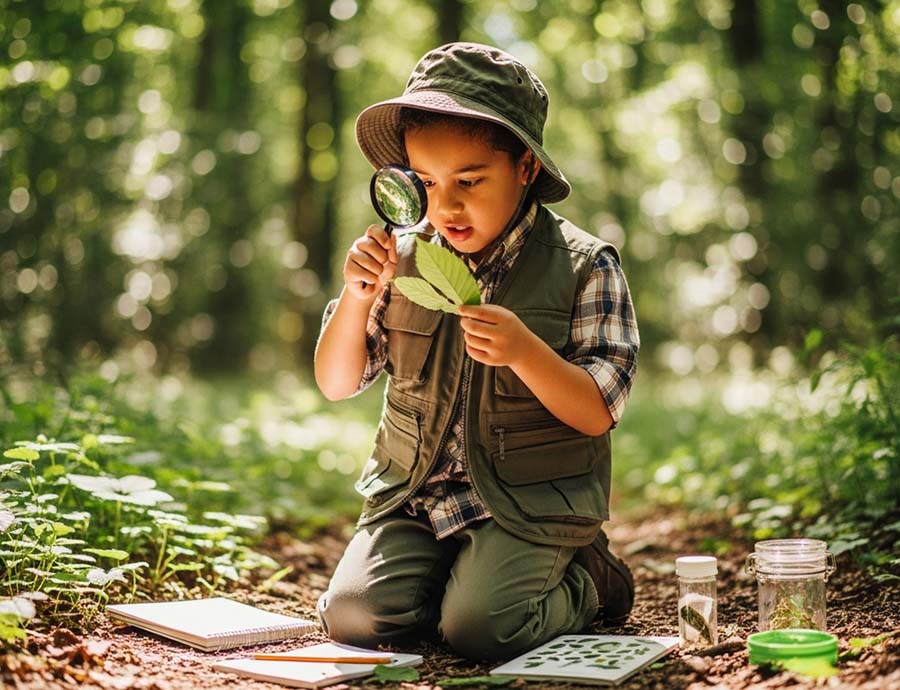
What Ecologists Really Do
Step outside on a warm day and really look around. A robin is pulling a worm from the grass, a bee is hovering over a flower, and a squirrel is burying an acorn near the roots of a tree. None of these things is happening by accident. Every animal, plant, insect, and patch of soil is connected to everything else in a web of relationships, and an ecologist is the scientist who studies those connections. Ecologists figure out how living things depend on each other and how the health of one species can affect an entire ecosystem.
Ecologists work everywhere: in rainforests and deserts, on coral reefs and mountaintops, in city parks and farming communities. Some focus on a single species, like wolves or monarch butterflies. Others study whole ecosystems to understand how water, soil, plants, and animals all fit together. They observe carefully, ask big questions, collect data, and look for patterns that explain how nature works. If you notice animals in your yard, wonder why some trees lose their leaves, and others keep them, or want to understand how everything in the natural world is connected, you might already be thinking like an ecologist.
You Might Love This If...

Skills That Follow You Everywhere
Being an ecologist builds skills that extend far beyond field notes and data tables. Ecologists learn to communicate complex science across very different audiences, adapt to unpredictable conditions both in the field and across a shifting research landscape, and maintain the resilience to keep doing meaningful work even when the findings are discouraging. These abilities are valuable in any career that requires clear thinking, flexibility, and persistence in the face of complex, long-term challenges.
Resilience
Ecology can be emotionally demanding work, and ecologists sometimes spend years studying an ecosystem only to document its decline or watch a conservation effort fall short despite the best science behind it. Resilience, the ability to absorb those setbacks, learn from them, and keep contributing to the long arc of environmental progress, is what sustains ecologists through careers that span decades of change. The most effective ecologists hold both the weight of what is being lost and the determination to keep building knowledge that helps things recover.
Adaptability
Field research rarely goes according to plan, and ecologists learn early to redesign their approach when weather shifts, equipment fails, or species behave in ways no model predicted. They develop the habit of finding creative solutions with limited resources and staying productive when conditions change without warning. This same flexibility serves ecologists when conservation priorities shift, funding landscapes change, or new technology opens up research questions that did not exist five years earlier.
Communication
Ecologists rarely keep their findings to themselves. They write research papers, advise government agencies, and translate decades of complex data into a single clear message for a news story or a community meeting, making science accessible to the people who need it to make decisions. An ecologist who can explain why a wetland's health affects a nearby town's flood risk, or why a missing predator changes what grows on a hillside, turns scientific knowledge into public understanding and action.
Explore more resources for a future Ecologist

National Geographic Kids Ultimate Bugopedia, 2nd Edition: The Most Complete Bug Reference Ever (NGK Ultimate Pedias)
Murawski, Darlyne | Honovich, Nancy | National Geographic Kids
Why We Picked It
Career Connection
Ecologists study the diversity, behavior, and relationships of species within their ecosystems, and the meticulous observation of insects that E.O. Wilson spent a lifetime refining starts here, with young readers learning to look closely at the creatures most people walk right past.

The Carnivore Way: Coexisting with and Conserving North America's Predators
Eisenberg, Cristina
Why We Picked It
Career Connection
Ecologists study trophic cascades, the way a predator's presence or absence reshapes everything below it in a food web, and the Yellowstone story running through this book is the field's most powerful demonstration of that foundational ecological principle.

Braiding Sweetgrass: Indigenous Wisdom, Scientific Knowledge and the Teachings of Plants
Kimmerer, Robin Wall
Why We Picked It
Career Connection
Ecologists seek to understand living systems in their full complexity, and Kimmerer's integration of scientific rigor with Indigenous land-based wisdom offers one of the most complete and humane visions of what ecological knowledge can truly be.