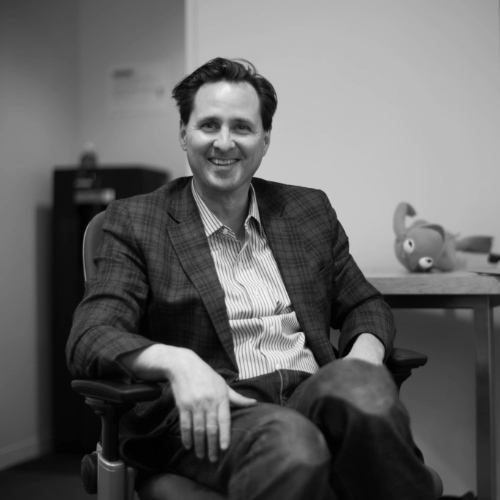
Photo: Joi Ito, CC BY 2.0 <https://creativecommons.org/licenses/by/2.0>, via Wikimedia Commons
Who He Was
Hugh Herr is an American engineer and biophysicist who leads the Biomechatronics research group at the MIT Media Lab and co-directs MIT's K. Lisa Yang Center for Bionics. Born in Pennsylvania in 1964, he was an accomplished rock climber by his teens. In January 1982, at age 17, he and a climbing partner were caught in a blizzard on New Hampshire's Mount Washington and stranded for three nights in temperatures well below zero. Severe frostbite led to the amputation of both of his legs below the knee, and doctors told him he would never climb again. Frustrated by how crude his first prosthetic legs were, Herr began designing his own, including specialized climbing feet, and within a year he was climbing at a higher level than before his accident. He later earned a degree in physics, a master's degree in mechanical engineering from MIT, and a doctorate in biophysics from Harvard. His lab created a computer-controlled prosthetic knee that TIME magazine named one of the top inventions of 2004, and the world's first powered ankle-foot prosthesis, which TIME honored in 2007. In 2011, TIME called him the "Leader of the Bionic Age," and he has received the Princess of Asturias Award and the Smithsonian's American Ingenuity Award.
Why He Matters
Hugh Herr turned his own hardest experience into a mission to make the technology better for everyone who came after him. His bionic limbs use motors, sensors, and computer control to imitate how real muscles and tendons move, and his newer research connects prosthetic limbs to the nervous system so people can feel and control them more naturally. In a famous 2014 TED talk, he introduced a dancer who had lost part of her leg in the Boston Marathon bombing, and she performed for the first time since her injury on a bionic leg his team built. Herr walks on his own designs every day and jokes that he feels sorry for people with biological legs, because theirs cannot be upgraded. For young people, his story shows that biomedical engineering can grow directly out of a personal challenge, and that refusing to accept "that's the best we can do" is sometimes the beginning of a career.