
Did You Know?
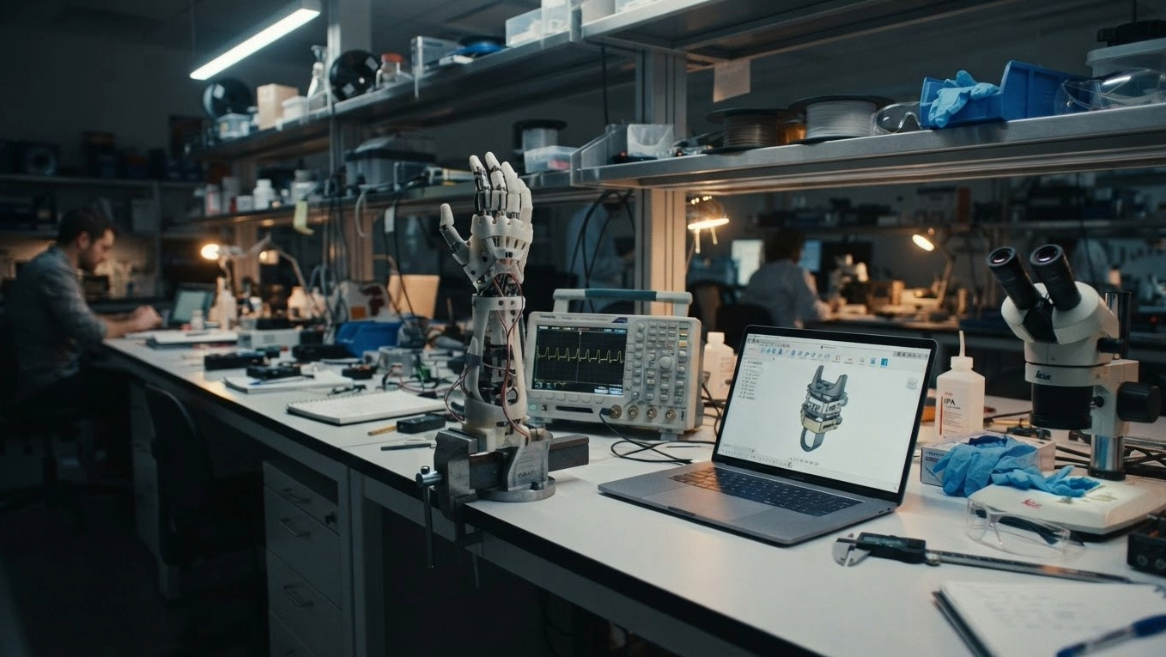
A robotic prosthetic arm approved in 2014 was nicknamed the "Luke" arm, after Luke Skywalker's bionic hand in Star Wars. It reads electrical signals from the muscles in a person's remaining arm, and testers could use it to zip a coat, turn a key, and pick up an egg without cracking it.

What Biomedical Engineers Really Do
Imagine a kid who loves to run but was born without part of one leg. Somebody has to design a leg that bends, springs, and grips the ground so that kid can race across the playground. That somebody is a biomedical engineer. Biomedical engineers are inventors who build things that help the human body: robotic arms and legs, tiny machines that keep hearts beating, and scanners that let doctors see inside a person without making a single cut. They mix what they know about science and the body with what they know about building machines."
Biomedical engineers spend their days in labs, hospitals, and workshops full of computers, 3D printers, and testing equipment. They might spend one morning drawing a new design on a computer and the afternoon watching a patient try it out. If something does not work the way it should, they go back and fix it, test it again, and keep improving it until it does. If you like taking things apart, building new things, and helping people feel better, you already think a little like a biomedical engineer.
You Might Love This If...

Skills That Follow You Everywhere
Biomedical engineering builds skills that reach far beyond the lab bench. Every project asks engineers to imagine something that does not exist yet, work through problems that have no obvious answer, and collaborate with people whose expertise is very different from their own. These are habits that serve people well in almost any career.
Creativity
Biomedical engineers are asked to solve problems that nature has not solved yet, like how to give a person a hand that feels natural or how to keep a heart beating with a machine the size of a vitamin. They learn to look at a challenge from many angles, borrow ideas from unrelated fields, and try approaches that might fail. Practicing this kind of creative thinking, where imagination is aimed at a real need, is valuable in art, business, science, and everyday life.
Teamwork
No biomedical engineer builds a device alone. A single project might involve surgeons, nurses, materials scientists, software developers, regulatory specialists, and the patients who will use the finished product. Engineers learn to explain technical ideas clearly to people who are not engineers, to listen closely to feedback from people who see the problem differently, and to keep a group of very different experts moving toward one shared goal. That ability to work well across differences is one of the most valuable skills in any workplace.
Problem-Solving
A medical device rarely works perfectly the first time. Engineers learn to break a big problem into smaller pieces, test one idea at a time, study the results carefully, and keep going when a design fails. They also learn to define what "working" really means, since a device that performs well on a bench must also be safe, comfortable, and reliable for a real person. This patient, methodical way of solving problems transfers to nearly every job and every difficult decision.