Photo: Cmichel67, CC BY 4.0 <https://creativecommons.org/licenses/by/4.0>, via Wikimedia Commons
Who She Was
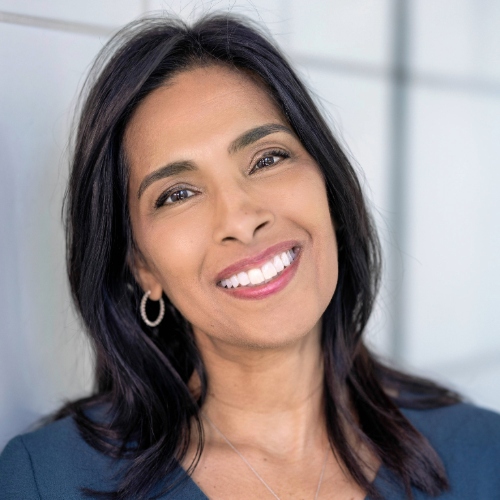
Sangeeta Bhatia is a biomedical engineer, physician, and inventor at MIT, where she directs the Laboratory for Multiscale Regenerative Technologies. Born in Boston to parents who immigrated from India, she loved her ninth-grade biology class and was good at math, but did not know what an engineer actually did until her father, an engineer himself, read about a brand-new field called bioengineering and took her to visit a lab at MIT when she was a teenager. She studied engineering at Brown University, then earned a master's degree in mechanical engineering and a doctorate in biomedical engineering through the Harvard-MIT program in Health Sciences and Technology, followed by a medical degree from Harvard. Bhatia borrowed techniques used to make computer chips to build tiny "microlivers," living human liver tissue small enough to fit on a lab plate, used to test whether new medicines are safe before they reach patients. She also invented nanoparticle "synthetic biomarkers" that can detect cancer with a simple paper urine test. In 2014, she won the $500,000 Lemelson-MIT Prize, often called the "Oscar for inventors," and she has helped launch several biotechnology companies based on her lab's work.
Why She Matters
Sangeeta Bhatia shows how a biomedical engineer can attack big medical problems by thinking small. Her microlivers give scientists a way to study drugs and diseases like malaria in human tissue without risking human patients, and her cancer-detecting nanoparticles are designed to work as a low-cost test that could reach people far from major hospitals. She is also a dedicated mentor who has spent decades encouraging girls and underrepresented students to see themselves as engineers, including founding the diversity committee of the Biomedical Engineering Society and helping start an MIT outreach program in 1993 that introduces young girls to science and engineering. Bhatia jokes that her family expected her to become a doctor, an engineer, or an entrepreneur, and she became all three. For young people who love biology but also love to build, her career proves you don't have to choose.