Did You Know?
A single jet engine has more than 20,000 individual parts, and aerospace engineers test how every one of them works together before the engine ever leaves the ground.
The Numbers Behind the Career
There were about 71,600 aerospace engineer jobs across the U.S. in 2023.
The 2023 median annual salary for aerospace engineers was about $134,800.
About 4,500 aerospace engineering job openings are projected each year over the next decade.
Where This Career Is Headed
Aerospace engineering is changing quickly as artificial intelligence, private space companies, and new kinds of aircraft reshape the field. AI-powered design tools now let engineers test thousands of possible shapes and systems in simulation before building a single physical prototype, dramatically speeding up the design process. At the same time, the rise of commercial spaceflight, reusable rockets, and electric aircraft is creating entirely new categories of jobs that barely existed a decade ago. Over the next ten years, engineers will need to balance these fast-moving technologies with the same rigorous safety standards that have always defined the field.

AI-powered design and simulation tools will let engineers test thousands of aircraft and spacecraft designs in the time it used to take to test one, speeding up innovation across the field.
The fast-growing commercial space industry, including reusable rockets and satellite constellations, is creating new categories of jobs focused on building and launching vehicles affordably and often.
Electric and hybrid-electric aircraft, along with urban air taxis, are opening a new frontier for engineers who want to rethink how aircraft are powered and flown in cities.
Education & Certification
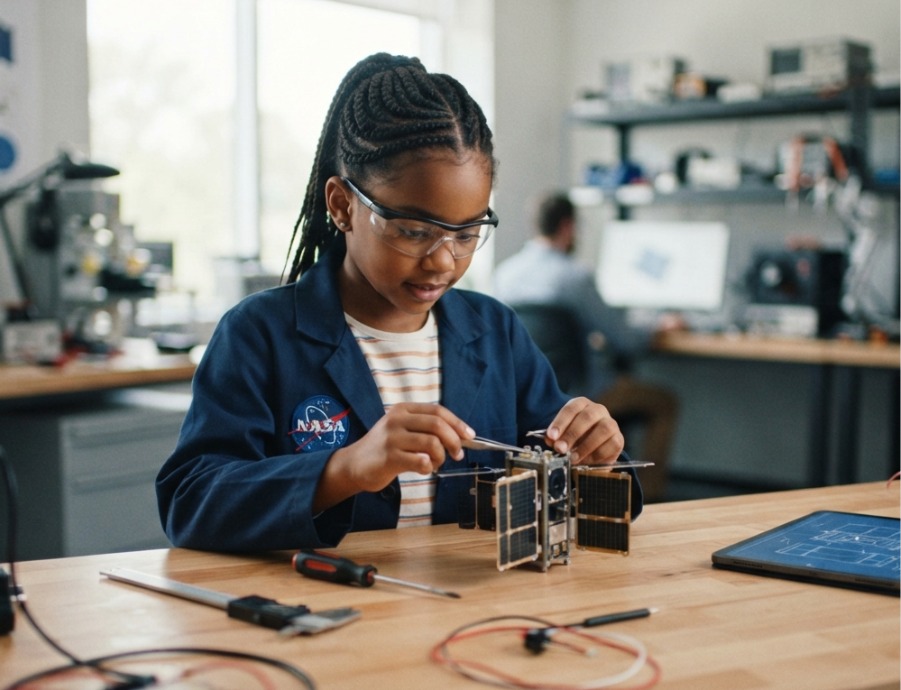
Most aerospace engineers begin with a bachelor's degree in aerospace engineering or a closely related field like mechanical engineering, from a program accredited by the Accreditation Board for Engineering and Technology (ABET), the organization that sets standards for engineering education. College coursework typically includes physics, calculus, computer programming, and specialized classes in aerodynamics and propulsion. Some engineers go on to earn a master's degree or doctorate, especially if they want to focus on research or highly specialized areas like spacecraft design.
To Prepare...
Take math and science classes seriously, especially algebra, geometry, and physics, since they form the foundation of engineering work.
Join a robotics, rocketry, or science club to get hands-on experience designing, building, and testing real projects.
Look for engineering camps, online courses, or competitions like science fairs that let you practice solving open-ended design challenges.
A license is not required for most entry-level aerospace engineering jobs, but it can open doors later in a career. Engineers who want to offer their services directly to the public, sign off on certain safety-critical designs, or move into senior leadership roles can pursue the Professional Engineer (PE) license, which requires passing exams and gaining several years of supervised work experience after college. Many engineers also pursue optional certifications in specialized software or systems, like CAD design programs, to show employers they have particular skills. None of these certifications are something kids need to think about now, but the good news is that strong math and science habits built today are the first real step toward all of them.