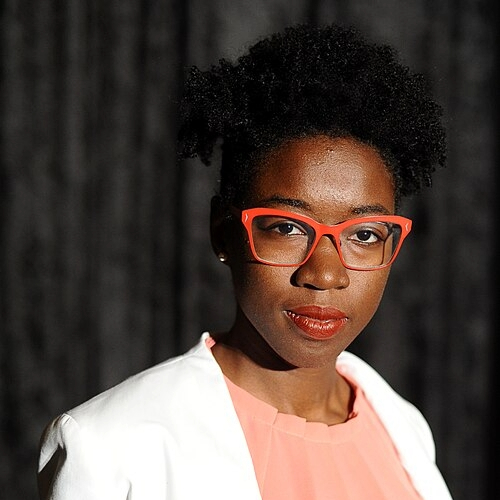
Photo: Niccolò Caranti, CC BY-SA 4.0 <https://creativecommons.org/licenses/by-sa/4.0>, via Wikimedia Commons
Who She Is
Joy Buolamwini grew up in Mississippi and first encountered algorithmic bias as a student at MIT, when she discovered that the facial recognition software she was using for a class project could not detect her dark-skinned face until she held up a white mask. That experience sent her down a path of rigorous research into how machine learning systems fail the people they are supposed to serve. She earned her PhD from MIT and founded the Algorithmic Justice League, an organization dedicated to identifying and challenging bias in AI and machine learning systems. Her 2018 study, co-authored with Timnit Gebru, tested facial recognition tools from major technology companies and found that error rates for darker-skinned women were up to 34 percentage points higher than for lighter-skinned men. Her research has been cited in congressional testimony and has directly influenced how companies and policymakers approach the fairness of machine learning systems.
Why She Matters
Joy Buolamwini's work makes visible something that is easy to miss when you are only looking at accuracy numbers: that a machine learning model can perform well on average while failing badly for specific groups of people, and that those failures tend to fall on people who were already underrepresented in the training data. Her research changed how the industry thinks about what it means to build a system that actually works, and her advocacy has pushed major technology companies to pause or discontinue facial recognition products that could not meet basic fairness standards. For anyone interested in machine learning engineering, her career is a powerful example of how technical skill, combined with a commitment to accountability, can transform an entire field. The problems she identified are not edge cases; they are core engineering challenges, and the engineers who take them seriously are the ones building systems that hold up in the real world. Her work is a reminder that who builds a technology and who they build it for shape what that technology does.