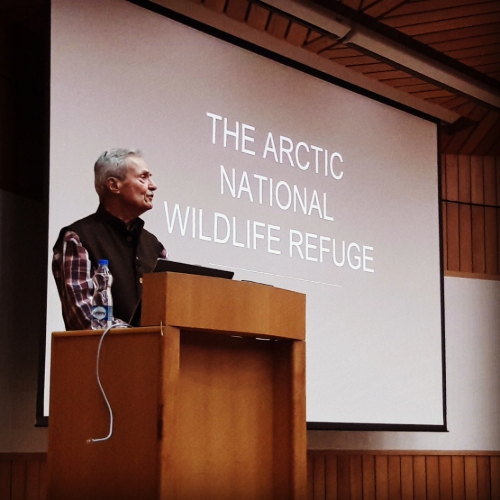
Photo: Ksuryawanshi, CC BY-SA 3.0 <https://creativecommons.org/licenses/by-sa/3.0>, via Wikimedia Commons
Who He Was
George Schaller is a field biologist widely regarded as one of the most accomplished wildlife researchers of the past century. Born in Germany in 1933, he built his career studying some of the world's most difficult-to-observe animals directly in the wild, including mountain gorillas in Central Africa, tigers and lions across Asia and the Serengeti, and giant pandas and snow leopards in the high mountains of China and Central Asia. His pioneering research on mountain gorillas in the late 1950s helped change public perception of the species from a feared beast to a gentle, family-oriented animal, and it later influenced the work of primatologist Dian Fossey. Schaller has spent decades affiliated with conservation organizations including the Wildlife Conservation Society and Panthera, and he has written more than a dozen books based on his fieldwork.
Why He Matters
George Schaller helped establish many of the field methods that wildlife biologists still use today, including long-term, patient observation of animals in their natural habitat rather than in captivity. His studies directly contributed to the creation of protected areas and nature reserves on multiple continents, including vast stretches of habitat in Tibet and China that protect species found nowhere else on Earth. He shared the 1997 Tyler Prize for Environmental Achievement, one of the top honors in environmental science, with primatologists Jane Goodall and Biruté Galdikas, and his book The Serengeti Lion won a National Book Award. For young people interested in wildlife biology, Schaller's career is proof that decades of quiet, careful fieldwork in remote places can shape how humanity protects entire species.